Sunday, 2 December 2007

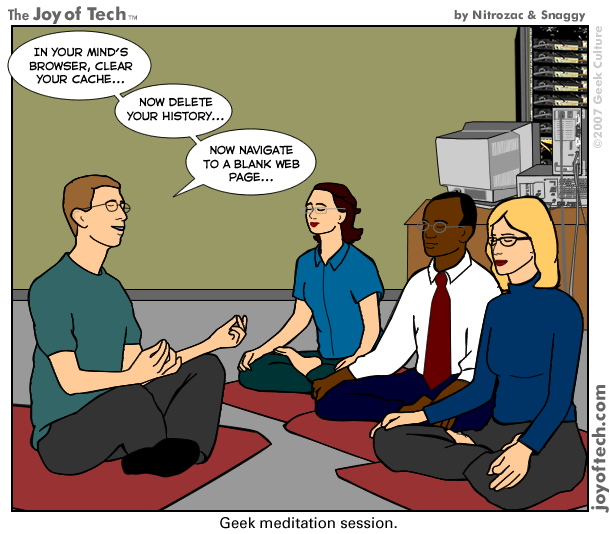
Geek Meditation


Received this link from a colleague through twitter this morning. Much appreciated.

Sunday, 8 July 2007

Narratives of Learning: Reflections on Seminars and Teaching as the Basis For Research

I have experimented with a number of different digital tools to present data collected in my classroom, to support essay writing and help me review and investigate learning events in my classroom. The tool I have found most valuable and powerful, and which I want to develop more widely with colleagues as an assessment and recording tool is what I have come to refer to as a "narrative of learning." A narrative of learning is quite simply what it seems, a learning story, an extension into the digital world, of something which was quite common in the primary classroom when I began teaching, the floor book. A "narrative of learning" can be developed using a host of readily available digital tools. I was privileged a couple of years ago to present with a colleague at the National Teacher Research Conference, where I drew on one incarnation of the tool in the form of a PowerPoint presentation, to support and form part of another in the form of a simple "video paper."

Video Papers are interesting as they are a relatively new forms of digital publication, and a medium in which some researchers are beginning to combine data in the form of multimedia, supported by traditional text types to disseminate and share findings. Using hypertext, the reports and documents, are divided into chapters and sub sections, where the use of a hyperlinking enables the reader to engage with the document in a number of different ways. For example the "paper" might be a collaborative exercise, involving a classroom teacher and an academic colleague, so we might structure it purposely to be written from two different perspectives, the teacher view and the more theoretical academic view. This on the surface appears not to be that different from a paper based document, we would still include the methodological processes, references to literature etc, but using the hyperlinked navigation structure we are able to read the paper in a non linear fashion, dipping in and out of areas of interest, or backtracking, perhaps clicking on a hyperlink to view the full reference, for a paper or author mentioned, or a back reference to something mentioned earlier or later in the paper, or to compare the teachers view on a particular aspect of the data with that of the professional researchers. We are also able to compare different perspectives on the same data, by having the analysis and review appear alongside the video, audio or image being analysed, without needing to take our paper apart, or flick back and forward between pages. From the point of view using digital and multimodal data, this can be incredibly complex to share in paper form, with video papers following initial stages in analysis we can select and embed samples from our data files so the paper can be read alongside it on screen. We can therefore watch and see first hand what the authors are evaluating and then use the hyperlink structure to see and read perhaps two comparative views of what is perceived as going on. Within this format however the reader can also be seen as co author, as they bring to bare their experiences, perhaps they see things differently constructing on the viewpoints presented in line with the evidence their own unique perspective. As these structures develop perhaps web 2.0 environments will be used to extend the interactivity of research papers and programmes with multiple author environments enabling, commenting to contribute to ongoing research, where perhaps part of the researcher role is to moderate these papers, as a single activity or evidence based task undergoes cycles of iterative refinement and teachers and researchers work alongside each other to form deeper understandings of each other's perspectives on classrooms and what constitutes learning. From a teacher point of view these are potentially powerful tools. They could facilitate engagement with ongoing research activities, while encouraging new ways of seeing. But perhaps what excites me more is the way in which the focus of such activities changes the way we see, from what we are delivering, to thinking about what students are receiving, and how they are learning. Changing the view of research from something which is done by others, to a basis for reflection, which sees classroom activity as the basis for research, reflection, and informed practice. These are key elements to me, that form the difference between teaching as an occupation and teaching as a profession. They also underpin for me one of the principle whys about assessing student learning.

Assessment for learning must be an essential element of research informed practice as it represents how we, iteratively engage with the learning process as it emerges in our classrooms on a day to day basis, identifying where students are and what they need to do next, identifying gaps in student learning and thinking about and informing how we support next steps in their development and understanding. Anyone who has worked with younger students will know that what we see in terms of recorded evidence particularly is not always what we get in terms of knowledge and understanding. Having carried out a writing task with emergent writers we invariably need to go back and have the students read their text to us in order to understand what they have written, and to understand how they are developing in their understanding of text as a semiotic process of representation. This enables a window on what they actually know rather than what is recorded and what we think they should know. This notion of what they should know, worries me as a teacher, as it stems from an over reliance on summative assessment activities, as evidence of learning by outcome. Far from the personalised learning approach identified in Every Child Matters, it consolidates the importance of a cohort mentality, being more about input and output on demand, than recognising the importance of the cultural and social origins of learning as shared meaning making. Classrooms as communities of practice, are not just boxes, they are social and cognitive melting pots where our learning is embedded in not only the artifacts we produce as individuals, but also in the experiences we bring to them and the ways we create and manipulate spaces to facilitate thinking together or the rehearsal, sharing and connection of ideas. These "interspaces" do not always represent the whole class, but frequently change as the result of the way we engage with each other and how we organise, plan and manage the learning process in our classrooms as they emerge. They are important I believe as it is through engagement here that we as teachers inform our choices about the tools we will use to mediate and orchestrate the shared meaning making which constitutes the achievement of our aims. The tools we use may include the physical such as pens, paper or the computer, but also the more ethereal and transient such as spoken language, or gesture. Capturing the latter as evidence of learning is difficult, they are fleeting and momentary, but no less important than the symbolic representation we feel we must have, if we are to understand what our students are actually learning, rather than what we think they are taking away from the encounters we have shared. They support a process which sees not only assessment for learning but also assessment as learning.

I have vivid memories of working with a year one student, as a probationary teacher. I had encouraged an emergent approach to writing, among a group students who were reluctant to write. She read her story to me, and I followed up by reading back, following the received writing direction. I began reading her story from left to right, top to bottom, pointing as I went, only to have her stop me to tell me I was reading it wrong, and beginning in the bottom right she began to read back, from bottom to top, right to left. I guess I should have been horrified that I had missed this earlier, but as a teacher still very much learning my craft, once I knew, I actually became even more excited than before, as I began to spot how she had represented words, using what she knew about how text is represented, the one to one correspondence of phonemes as well as her emergent narrative to construct her text. I had also identified one of the gaps in her meaning making process, and the next steps I needed to take in my work with her and the class as emergent writers, in order to ensure that she and they always followed the writing directionality convention. I booked the school's single BBCB and used the word processor to help develop and consolidate this, using this as a model among many, offering it as a place to draft on screen, and print out texts as well as using pencil and paper models and emphasising left to right directionality when reading. This process is a constant reminder to me of the dangers surrounding making assumptions about what our students receive, and has lead, even when working with older students to a reluctance to rely on what they have written or recorded as reliable evidence of what they have learned. Learning about learning is the academic challenge of what it means to be a teacher, and as research practice in the everyday, this is the primary purpose of assessment for (or should I say "as") learning.

So.... Returning to Narratives of Learning, how have they helped me, and why do I think they are so powerful. Working iteratively with colleagues at the University of Bristol, on "ways of seeing" I was encouraged to think about how I might adapt some of what I was learning to explore more closely what learning looks like in my classroom. Much of the work students do using ICT, is practical and may not always be transparent, or physically evident through the outcomes they produce in a session. As I introduced the Interactive Whiteboard to my Numeracy Hours, I began to find myself increasingly drawing on speaking and listening activities to encourage "thinking together," supported by informal jottings and small whiteboards to scaffold this. This began to conflict with wider expectation that something should be be recorded in books from every session. IWBs as learning tools, like other technologies are seen in publications as "transformative tools." But with students cleaning boards in between tasks, the "evidence" of outcome was gone, and an emphasis on student recording seemed to devalue talk and group interaction as tools for shared meaning making. Amid our concern about the elimination of this "data" or "evidence" once an activity was complete, I turned to digital means of representing this, and an engagement with the development of learning stories.

Combining the use of the digital camera, card reader, computer, IWB and notebook Software I began to work with the students capturing them and their work as they engaged, using the images downloaded to support discussion. Taking and recording notes about what the students were saying as we worked together as a class, I was increasingly able to use photographs captured there and then to help facilitate and support this, or to provide feed back from the previous day's activity. Including these in PowerPoint Shows, that represented a teaching sequence with some areas the students found difficult I was increasingly able to use these as starting points and focal points for review when we returned to an idea later. For the Video Paper above, I tracked a unit of work where we used student's informal jottings to develop a written method, building on mental strategies, and using the learning story which evolved to help them see the links between the strategies they commonly used and the formal method we were expecting them to use. This was at times arduous and time consuming, but as a process really helped me to understand what it was that I was expecting of my students, and some of the common misconceptions they were taking away from the tasks we were developing. This did not only transfrom the learning context, but has also changed the way I view the teaching and learning of calculation, enabling me to see links between strategies and methods I had not seen or thought about before. With the emergence of the visualiser as a tool I now have the potential for direct digital capture of student work, and on screen annotation for inclusion in these notebooks, or to support the development of learning stories in software environments such as PowerPoint, as well as to improve the pace of activities which draw on or that I want to digitally store or engage with. This will certainly improve pace and the amount of time lost in importing images by other digital means.

The idea of a narrative of learning has taken on a whole series of new dimensions for me this year. As a socially constructed journey towards understanding, classroom learning in context must have a back story about what we have achieved together. The technologies I have used with students have progressively lead to a feeling that I need to share responsibility for logging the learning journey with my students. Podcasting tools such as Podium combined with the use of recordable MP3 players could lead to captains log stardate.... type reflections from reluctant recorders or even challenge the traditional writer to construct texts in new and different ways, while collecting their thoughts, the use of digital cameras as integral to the recording process could help with the embedding of multimedia authoring platforms such as Photostory, 2 create a story and PowerPoint in enabling group and class texts to be developed from the digital media collected in the classroom and encourage representation of process as well as outcomes through stories of learning multimodally, while the use of the class blog acting as part of the school website will enable students to jointly author, celebrate and publish learning logs, creating a sense of ownership and authorship of learning, while encouraging feedback and involvement from others about what we have been doing. There is an inbuilt sense of purpose when their is an audience to share our learning with, the quality of text development in our think spaces and PowerPoint while preparing for the Airbus challenge presentation reflected this. Yesterday the perseverance, self reflection, acceptance of critical friendship, self correction, recognition of the temporary nature of data, and willingness to rerecord aspects of the podcast some of the year 3s were making until they agreed that it sounded right, and reflected what they were trying to say, reflects for me how this is one of the ways to go with my students over the coming year. Just as learning about learning is the research domain of the teacher, then learning how to learn must be the domain of the student. It is of real interest to me how as technologies evolve our practices with them have changed little. Having attended sessions lead by Stephen Heppel, David Puttnam and Alan November recently, it is even more apparent that we must radically alter our view of what teaching and learning means in contexts where ICTs are employed. Shifting from seeing them for example as part of a delivery system, to adopting a multiple tool approach which sees technologies as combining with the creativity of the teacher to offer support for learning, This position not only sees the students in our care as learners, but also places us in this position, one where we are frequently outside of our comfort zone. Transformation and change is never easy or certain but one thing that is increasingly sure is that in the rapidly developing technological world change is the one constant. One which we must learn to accept, and where teachers must learn to see students differently, as coauthors of each other's understanding.

Friday, 6 July 2007

It all Depends How You Look At It

Attended the West Of England ICT Conference this week, fantastic experience to have the chance to hear Stephen Heppel speak, and to explore and think about his views not only on ICT in education but perspectives on the future of learning spaces. He showed this video, which I'm posting hear so I don't lose it, and as it reminded me of some of the things I was thinking aloud about in my last post. It truly does depend on the experiences we bring to a video, as to the outcomes we take away.


This one is here just for fun.

Sunday, 17 June 2007

Video Data, Comic Strips and Learning Stories

Finally got back to my Masters Dissertation this week, and began by reading a thought provoking paper, by Lydia Plowman and Christine Stephen, of the Interplay project based at The University of Sterling. I had the priviledge of meeting Lydia a few years ago, at the CAL'05 Conference. Some colleagues and myself, had also presented our emerging work from a Research Project based at The Graduate School of Education in Bristol, as a symposium. Our methodology then as mine does now involved the analysis of video data collected in my classroom, and since this medium was also used by Interplay I was very interested to hear what Professor Plowman had to say. In the case of my current project, the data was collected by colleagues during the InterActive Project. It involved video capture during 8, Year 4 numeracy hours, where the students used Excel in guided investigations, to support exploration of the functions of graphs and charts. As my Tutor can verify, and I have to say she has been incredibly patient with my perfectionist attitude, I have spent a considerable time stumbling around the methodological process, not the analysis per se, but the sheer volume of data collected, and how I am actually going to write it up. There is also, an at times, alarming character based facet to this, in that everytime I come back to it I find something new, and with this a new set of questions emerge. This is an unfortunate by product of a rambling mind and not a lack of focus in my questions.

We have used the idea of "iterative cycles of review" as a way of facilitating "ways of seeing." Video at first hand seems to offer a cornucopia, but it is easy to make assumptions that what we see is what we get, and to assume that everyone will read the data and see the same things that we do. This however is frequently not the case. Lets take the example of a visit to the cinema with friends. On leaving we may have all watched the same movie, yet from the discussions which emerge you could be mistaken for believing differently, as the group identify different parts of the film to talk about. Taken out of context, by an outsider listening in, these apparently disperate episodes would seem disjointed, even alien and have little meaning. There may be common high impact moments, but more often than not we highlight very specific individual moments of interest, parts that stood out and had personal impact and meaning for us, and which are very different to those of our friends. Even the same episode, might be described from a different perspective, the visual effects, the protagonists reaction and so on. As the discussion evolves we might eventually come to focus on specific moments, as the outing was a social event and we seek to create a common experience from the whole we have shared. Our approach to "Iterative cycles of review," involved a similar idea, a number of "viewers" worked together collaboratively to identify common themes within data collected, and using our shared experience over time set out to negotiate common meanings through discussions mediated by the data we had engaged with, attempting to tell a shared story based on the common experiences presented in the evidence we had evaluated. Within the analytical process for the symposium above we also used the Studio Code software environment, to tag episodes from the video which corresponded to instances of events and actions within categories we had agreed upon and identified in the data. This introduced some interesting questions for me around perceptions of what happens when children are learning in teacher designed ICT mediated situations, the role of the teacher, and what learning looks like during ICT supported tasks, and so my return to the original InterActive Project data I am using for this project.


In the Plowman and Stephen paper, the authors have used Plasq's Comic Life, to present screen captured video data alongside captions and examples of dialogue between adults and students in the preschool/foundation stage playroom to exemplify particular forms of what they call "guided interaction." They use comparisons between ICT and non ICT based activities as frames to support "ways of seeing," and presenting how interactions observed within more traditional activities, might be developed, evolve and compare with interactions mediated by ICTs as learning tools. The use of the comic strip format sets out to share what has been learnt from their research and as well as forming part of the frame used in data analysis, is intended to support the dissemination process of findings to pre school staff, helping them to identify examples of guided interaction within their use of technology.


I am very much an amateur Mac user, and "emergent researcher." My Mac has largely been employed for multimedia work, video editing and the like, but I was so inspired by what I read, I felt I ought to try out the software, which I feel may help me present the data I want to discuss in my project submission. It also has the potential to extend my current assessment for learning practices and evidence collection activities as I prepare my porfolio for NAACE Mark assessment. In previous assignments for my degree I have presented data from video as "snippets from Learning Conversations." or as "Narratives of Learning." using text supported by images captured from video, or linear presentations using PowerPoint to support observations, analysis and presentation of visual evidence. These digital PowerPoint learning stories (Narratives of Learning), have proven to be useful tools in presenting classroom learning as it unfolds through linked events emerging from the class as a community of practice. I have however become increasingly aware through engagement with video captured of my students at work of the dangers of focussing solely on "the moment," and using dialogue and conversation as evidence when observing students using ICTs. I have also begun to think about what I have come to see as "meaningful inactivity," times when students seem not to be involved physically or verbally with a task at the computer, but when asked about this are able to discuss what they and their partner have been doing or what they have learned from the experience. This type of action has drawn into focus, some practical everyday issues, like those annoying moments when a student who has apparently not engaged with a class task, is then able to relay what has been happening around them. There are also occasions when single word utterances between students seem enough to change the direction of a computer ( or non computer) based task, however when these utterances are viewed within the original context of the video, gestures and visual feedback from the screen become part of a more complex picture than this apparently simplified student discourse would tend to suggest. Language may be a key support in the movement of a task, but the other tools used also seem to mediate and facilitate changes in direction through feedback, with the gesture and motion of the participants communicating what they would like to happen. The richness of the visual and verbal context presented in the video from the activity system which evolves around in this case the computer presents a much broader context to the activity from which so much can be lost, as elements are removed during analysis. And here in lies my conundrum, how to present this richness. I have used a range of methods, including transcription and an emerging framework for multimodal analysis of the data so far, but this is heavily dependent on detailed description, and reliant on the written word to provide context for the activities and actions of those involved. Maybe a multimodal approach to presenting data, will help support the refining of the analytical and presentation process. It will be interesting to see whether using the comic strip format will enable me to engage with the data and tell this particular set of learning stories, while enabling me to visualise and formulate more clearly what the evidence seems to be telling me about what learning looks like as action in ICT mediated situations.